Commission President von der Leyen sent a letter to the Cypriot Presidency of the Council and to the President of the European Parliament yesterday 6 January 2026, in which she proposed to make additional resources available as of 2028 to address the needs of farmers and rural communities (with thanks to Politico Europe for the link).
This letter was sent on the same day as the Cyprus Presidency invited all Agriculture Ministers to a meeting also attended by the Commissioners for agriculture, trade and health to provide reassurances to Italy and other Member States to sign up to the contentious EU-Mercosur free trade agreement on Friday. The proposal in the letter would be a form of side-payment to bring the wavering countries on board.
The formal part of the proposal, in an annex to the letter, proposes to add a new sub-paragraph to Article 14 of the National and Regional Partnership Fund Regulation which sets out how the resources made available under the so-called General Allocation of the Fund can be used. Specifically, the following text would be added to Article 14.
“When submitting or amending its plan before the midterm review, Member States may use up to two thirds of the amount available for the midterm review for interventions referred to in Article 35(1) or for measures dedicated to rural areas.”
The flexibility amount
As this paragraph is pure legalese, I provide some context in this section. We first need to understand the notion of a flexibility amount. This is defined in Article 14(2) as money that is available to a Member State under its NRP Fund in the 2028-2034 period but which cannot be programmed immediately and which must be held in a flexibility reserve.
This flexibility amount is significant. It amounts to 25% of the General Allocation in the NRP Fund less an amount that is broadly the ring-fenced amount for CAP income support. The General Allocation, in turn, is the overall size of the NRPF less the minimum ear-marked amount for migration, security and home affairs.
In calculating the size of the flexibility amount, I say that the deduction from the General Allocation in the NRP Fund is broadly equivalent to the ring-fenced amount for CAP income support. This is because the minimum amount earmarked for the Fisheries budget (which the Commission has now formalised at €2 billion in its non-paper presented to the Parliament in November 2025) is also included in this deduction, but the amount that Member States allocate to investment support for farmers and foresters will be excluded when calculating the deduction and thus the size of the flexibility amount.
The use of the flexibility amount is strictly regulated in the NRP Regulation. One-fifth of the amount can be used by Member States to provide assistance in the case of natural disasters, adverse climatic events, and animal diseases in the first three years of the programming period 2028-2030-
Another three-fifths (plus any unused amount from the first fifth) is available for programming at the Mid-term Review which should be completed by 31 March 2031. While the Mid-term Review provides an opportunity for a Member State to revise its targets and instruments, the intention of the Commission is that the flexibility amount means that Member States will also have additional resources available to address any new challenges that might have arisen between agreement on the NRP Plan and 2031. Part of this reserve can be brought forward and used for programming at the request of a Member State “in duly justified and exceptional circumstances”.
This leaves the remaining fifth of the flexibility amount can then be requested as of 2031 again to provide assistance in the event of crises. If there is still unused amounts as of June 2033, these amounts can be made available for programming for any amendment of the Plan.
Neither the general objectives for the NRP Fund (Article 2) or its specific objectives (Article 3) specify that the Fund can be used to provide assistance for natural disasters or climatic crises, although this is provided for in Article 34 of the NRP Regulation.
The 45 billion euro question
Against this background, we can interpret the significance of the Commission proposal presented yesterday.
The Commission has consistently presented the ring-fenced amount for CAP income support as a minimum amount, which Member States could add to from the unearmarked amounts in their NRP Fund allocations (minimum amounts are also earmarked for less development regions and for migration, security and home affairs). A big constraint on Member States being able to programme additional amounts for the CAP, apart from political battles within Member States on the priority to be given to the CAP and cohesion spending, is the Commission proposal to freeze most of the programming the flexibility amounts until at the earliest the Mid-term Review.
The Commission proposal is that (a) two thirds of the flexibility amount reserved for the Mid-term Review can now be programmed from the start of the programming period but (b) only if this forwarded amount is used for CAP spending. The attraction for Agriculture Ministers is that this not only unfreezes resources and makes them available for programming from the start of the programming period, but it locks in that these unearmarked resources have to be used for the CAP.
Critics will correctly point out that this amount is not guaranteed additional spending. It does not increase the minimum ring-fenced amount for CAP income support. But it will give Agriculture Ministers a stronger negotiating hand within their Member States. They will now be able to point out to their Finance Ministers that if the amount is drawn down immediately from the EU budget and used for the CAP, the money becomes available to the Member State from 2028 instead of having to wait until 2031 to unfreeze these amounts. For example, if 20 Member States decide to make use of the option but 8 do not (counting Belgium as 2), there will be significant additional pressure within the 8 countries to follow suit.
Any funding additional to the minimum ringfenced funding for the CAP will require national contributions from Member States depending on the appropriate co-financing rates set out for the specific type of region where the expenditure takes place. There are no requirements set on the types of CAP interventions that Member States can support with this additional funding.
Given the lack of minimum ringfencing within the CAP budget for agri-environment-climate actions, a case could be made that additional funds made available for the CAP in this should be confined to these environmental interventions. However, given the political purpose which this side- payment is intended to achieve, expecting this kind of fine-tuning was always going to be unrealistic.
The additional text proposed by the Commission also allows the unfrozen flexibility amounts to be used for measures dedicated to rural areas. To the extent that Member States favoured rural development measures, this would reduce the additional funding that would directly benefit farmers.
The CAP through its Pillar 2 always included measures designed to support rural development, including LEADER and rural business support schemes. In its November 2025 non-paper to the Parliament, the Commission had already proposed to amend the NRP Regulation to include a dedicated target for rural areas. It had proposed that at least 10% of the NRP Fund General Allocation (again after deducting the minimum amount for CAP income support) should be dedicated to rural areas, calculated by using the code 02 in the Performance Regulation. This refers to any expenditure that takes place in a rural area and is thus a much wider definition of rural development expenditure than traditionally associated with the CAP.
In this way, expenditure traditionally funded by cohesion policy can also be funded from the unfrozen flexibility amounts. This will please advocates of cohesion policy who otherwise have been dismayed by the apparent ability of farm groups to ‘jump the queue’ in accessing unearmarked resources under the NRP Fund. However, for the same reason, this broader remit for the use of the unfrozen resources may limit the extend to which farmers will benefit.
A final element in the Commission proposal confirms that farmers will still be able to access the unprogrammed amounts in the Flexibility Amount for assistance in case of natural disasters, adverse climate events and animal diseases. The sums are substantial, amounting to 10% of the General Allocation in the NRPF Fund less broadly the ringfenced amount for CAP income support.
Impacts will differ across Member States
If all Member States made use of this option in designing their NRP Plans, and if expenditure on rural areas was limited to interventions, such as LEADER, traditionally funded from the CAP budget, it would add a further €45 million to the minimum CAP ringfenced budget of €293.7 billion, or an additional 15%. By highlighting also the doubling of the agricultural crisis reserve in the new Unity Safety Net, and as well the possibility of benefiting from borrowing under the Catalyst Europe fund (an option which I highlighted in my previous post on this blog), the Commission concludes that
“the combination of these policy and budgetary tools will provide the farmers and rural communities with an unprecedented level of support, in some respects even higher than in the current budget cycle…”.
However, there will be very different impacts across Member States (Table 1). In this table, I have calculated the maximum additional impact the Commission proposal would have on the CAP budget available per Member State. There is an extraordinarily consistent pattern. All recently-acceded countries would gain more than the EU average in additional spending (for example, Slovakia 39%, Poland 35%, Hungary 28%). On the other hand, all older Member States (except for Portugal and Greece) would receive a smaller increase in their CAP budgets compared to the EU average. While the increases for Italy (15%) and Spain (11%) are significant, the increases for France (6%), Austria (4%) and Ireland (4%) are hardly so.
From a Mercosur perspective, Giorgia Meloni handsomely succeeded in her objective to gain additional support for Italian farmers, while other major opponents (France, Austria and Ireland) fared less well.
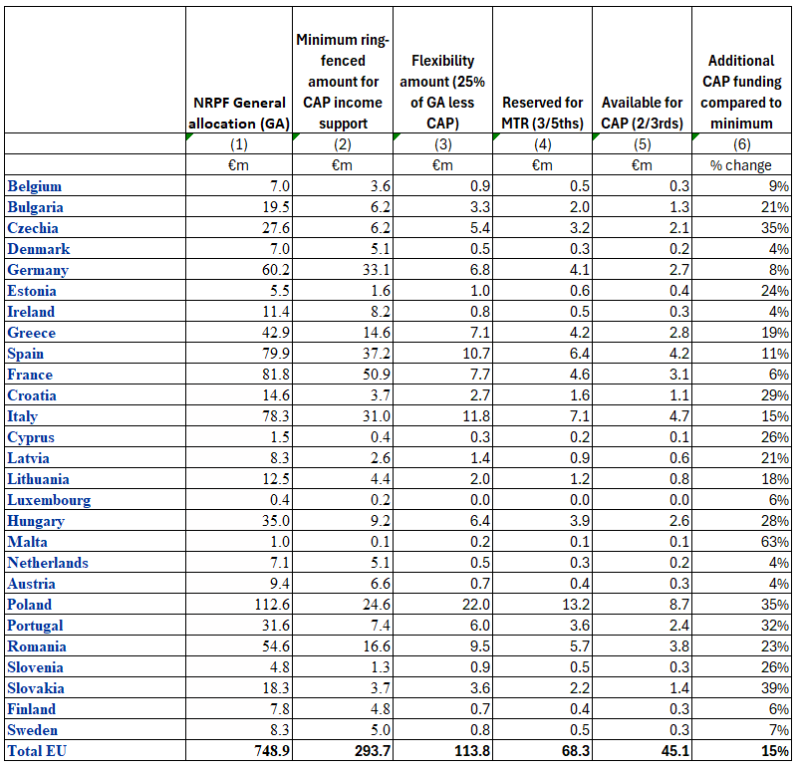
Notes: The flexibility amount is calculated by deducting the minimum CAP income support amount in each Member State from its NRP Fund General Allocation. As noted in the text, this amount should be increased by the Fisheries budget but decreased by the (as yet unknown) amount allocated to investment support for farmers and foresters in the NRP Plans. The sums in column (2) are thus an approximation.
Source: Commission Fact Sheet, Europe’s Budget Member States allocation, 2025.
This post was written by Alan Matthews.

O artigo foi publicado originalmente em CAP Reform.